Goldmund’s death
Narcissus and GoldmundGoldmund’s death closes his life of wandering and creation by turning his final illness into a last conversation about love, art, and the mother he has sought in memory and imagination. His body fails after a journey marked by hardship, but the decisive movement is inward: he gives up the hope of completing his long-imagined maternal statue and understands himself as being shaped, at the end, by the mother-image he once hoped to shape in wood. Beside him, Narcissus at last speaks openly of his love, making their friendship part of the death scene rather than merely its witness.
Return and Final Illness
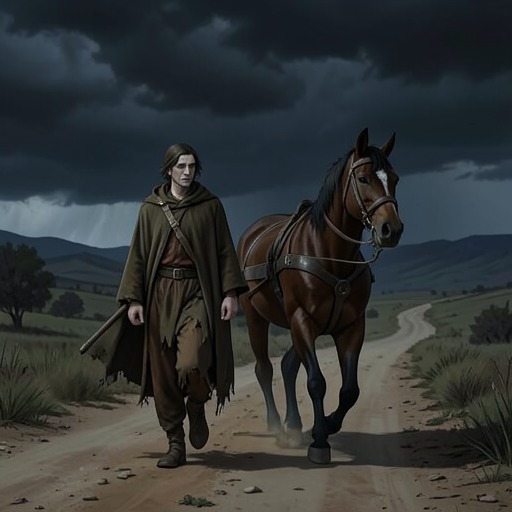
Goldmund returns to Mariabronn sick after a journey whose full story is never known. He tells Narcissus that his chest pains began when he fell with his horse into a brook and lay there through the night. He believes he broke several ribs, but initially refused to turn back because he feared that doing so would make him look foolish. When the pain eventually made riding impossible, he sold the horse and spent a long period in a hospital. His account makes the illness a consequence not only of physical hardship but also of his determination to continue outward, even when his body had already given him reason to stop.
Back at Mariabronn, Goldmund resumes drawing and making figures, but his strength is spent. While speaking with Narcissus, he stops, closes his eyes, and falls peacefully asleep at the drawing table. The Abbot fetches Father Anton, who finds him hopelessly ill; Goldmund is carried to a sick room, where Erich keeps watch. His condition alternates between listlessness, fever and delirium, and periods of lucidity. Narcissus is summoned during those lucid intervals, and their conversations become increasingly important to him. The narrative does not provide a complete record of Goldmund’s last journey or all that he says: Narcissus preserves fragments of his reports and confessions, while Erich supplies other details.
Narcissus and the Last Reconciliation
The final illness brings a change in the intimacy of the two friends. When Narcissus puts a hand on Goldmund’s arm, Goldmund immediately falls quiet and closes his eyes. Later, as he sleeps at the drawing table, Narcissus bends down and kisses his hair and forehead—a gesture he had never made during their many years of friendship. Goldmund understands what the gesture means. Narcissus then admits how much Goldmund has meant to him and how poor his own life has been in love. He tells Goldmund that, among men, Goldmund alone has enabled him to love, and describes that love as a well in a desert and a blossoming tree in the wilderness.
Goldmund receives this declaration without shame. He recalls that, when Narcissus visited him in prison to save his life, he had felt ashamed in front of his friend; now, he says, that shame is gone. The exchange makes the deathbed a place of reciprocal recognition: Narcissus gives voice to a love he had left unspoken, while Goldmund meets that confession with the ease of someone who has known the love of many women but now recognizes the singular place Narcissus occupies in his life. Their parting does not erase their differences; it allows them, at last, to name what those differences have not prevented.
Death, the Mother, and the Unfinished Statue
Goldmund speaks of dying without claiming faith in an afterlife. He says he does not expect the dead to return: a dried-up tree remains dead, a frozen bird does not come back to life, and a person’s memory eventually fades. What draws him toward death is instead the hope that he is traveling toward his mother. He imagines that she may come to take him back, not into another life, but into nonbeing and innocence, and hopes that this return may bring a happiness like fulfilled love.
That hope is inseparable from the artistic ambition he cannot fulfill. For years he has wanted to carve a statue of the mother, the most sacred image he carries within him. Earlier, the image had been connected to his own mother and her memory; it had continued to change as his experiences and encounters with women shaped it. Goldmund had once believed that his life would be useless if he died before making the statue. Now he describes the reversal: it is not his hands that shape the mother’s image, but her hands that shape him. The image of the great mother-Eve remains visible to him, and he believes he could carve it if his hands still had strength, yet he also believes that the mother does not want him to make her secret visible. The sculpture remains unrealized, while the act of dying becomes, in his understanding, the mother’s work upon him.
In his last exchange with Narcissus, Goldmund asks how Narcissus will die, since he has no mother. He tells his friend, “Without a mother, one cannot love. Without a mother, one cannot die.” These words join the two subjects that have governed his final reflections: the maternal source of love and his own expectation that death will be a return to that source. What follows cannot be understood. For the last two days, Narcissus sits beside Goldmund’s bed as his life ebbs away, and Goldmund’s final words remain with him.
The Death Scene’s Wider Echoes
Goldmund’s death gathers into a final scene the bodily and artistic experiences through which he has tried to understand mortality. As a young wanderer, he witnessed a birth and was struck by the resemblance between the expression of pain and that of ecstatic pleasure. Later, in a plague-stricken farmhouse, he studied the dead with both compassion and the artist’s exact attention, seeing how posture and gesture gave form to different experiences of death. During his journey through the plague region, a painted Dance of Death presented mortality as an unavoidable end shared by every social rank. Goldmund found that stern image incomplete beside his own sense that death could also be maternal and inviting. His final hope that death will lead him toward his mother brings that earlier understanding to its personal conclusion.
The unfinished maternal statue also stands against the completed religious works that mark Goldmund’s artistic life. He had been drawn to Master Niklaus’s wooden Madonna and later worked on a statue of Saint John, whose features he associated with Narcissus. Back at Mariabronn, he planned a refectory lectern whose lower section would represent creation and the lives of patriarchs and prophets, while its upper parapet would bear the four apostles. These works show his ability to give form to remembered people, religious figures, and the life around him. The mother, by contrast, remains the image he cannot make public. His death therefore ends not with artistic completion, but with a final recognition that the central image of his life exceeds the work his hands could finish.